Thursday, November 11, 2010

Setting the Scene: The Philippines

From Kingdom without borders by Miriam Adeney:
“The sun goes down in the blink of an eye in the tropics, but the evenings stretch out wonderfully. People amble, gratefully inhaling the night breeze. Friends laugh, families meander companionably, couples nuzzle. Vendors, alert and awake, cater to everyone’s desires. In upscale places like The Fort or the Mall of Asia or the Podium, stylish people flock to coffee shops and bars.
Yet not far away, cardboard shacks hover on the banks of fetid canals thick with unspeakable garbage. The night breeze and the family and friends and vendors are here too, but the options are limited and the milieu squalid.” (Adeney, 13-14)

This is the Philippines. Small Islands known for their big cities with apartments of concrete and tin roofed shacks. Tropical foliage, mango trees, palms, and flowers. The crowded streets full of bikes, trykes, food carts, jeepnies, and people in flip flops wearing thin clothing. White powdered faces coming in and out of convenient stores selling home goods, local movies and music carrying sun umbrellas. Food carts with roasted chicken and other items on a stick, open-air markets with chickens bound at the feet, and fast food Jollibee standing happy guard outside. This is one version of this country. City life.


The other is right outside the gravel or concrete streets where the road becomes mud and dirt. And the homes become thatched collages of spare sheet metals, dried palm leaves, and old pop music or political posters. Built around waterways where children play in the local dumpsite, sewage waste, drinking water and swimming pool all in one. Wires and antennas strung from home to home held on by pieces of bamboo and duck tape connecting these villages and neighborhoods to the tube. Dirt yards with plastic chairs outside where children play with stones, sticks, and if they are lucky a cheap colorful plastic ball. They wear even thinner clothes some with holes, small dirty shorts, skirts, and t-shirts advertising off-brands in Tagalong, English, or Chinese or with skewed images of famous cartoon characters on them. This is another version of the country. Suburban life.


The last is even further out of town in the arid wasteland. Where the foliage disappears and mango trees do not offer fruit falling down a crevice of a tin roof. The roads are dusty and wide connecting one larger suburb or city to another. But there is life in-between, ignored as an unpleasant blur and smell on the side of the roadway. Some small huts outside known as sari-sari stores house small amounts of products from the city: candy and soda, chips and cosmetics, soaps, shampoos, and laundry powder. The entryway is met with a few homes-the nicer version of what is to be seen further and deeper into the village. They are made of spare parts and pieces: more tin siding and roofs, posters, rotting wood, a bamboo strung door, and rusted and crooked nails or duck tape holding the leaning and buckling structures against each other. Here a meal is served once every three days. Children run around with even thinner clothes that look more like cloth napkins with holes bigger than quarters in them. If the children are wearing clothes at all-it may be washday and they lack pants or a shirt or both. They run around trying to find ways to waste their energy, too young to work. Those who can work are found further back in the village in the mountain landfill: the dumpsite. Where unmarried women and men of all ages work picking through the trash and leftovers from the city scavenging for goods that can be kept, or polished, reshaped, and sold. Blackened by their hours in the sun they are treasure seekers, looking for money in another man’s trash hoping to find enough to provide the family’s dinner in two days. Or to find a new siding to the house, a new piece of cloth for carpet, a new stick to poke the garbage with the next day they work. This is the often untold version of the country: the outcasts: the squatters: the Dumpsite people.


These are the poorest of the poor.
So what happens when all three versions of this country collide?

To be continued . . .

P.S.- for those of you who can relate to seeing similar situations (any of the three pictures I describe) in other countries please feel free to share your memories, feelings, and reactions. If you have not, feel free also to comment of course on your thoughts in reading this :)

-sorry if the pictures are too small-anyone know how I can make them bigger?

Saturday, October 30, 2010

Storytelling

As some of you know I started this blog so my friends and family could keep track of my travels through the Middle East this past spring. Well my many college travels are over but my experiences and the memories remain.

I feel blessed by these memories and sometimes the ability to express them in a way that others can feel them come alive again.
I ask God to remind me of what I have seen and heard-and I will have flashes-glimpses into moments.
Those moments that are unexpected, that put you in awe and amazement- fill us with joy and laughter- or weakens your knees and makes your heart turn to lead- all significant -all should be told.

We live in a culture where story telling is something people do when they are done living their lives; for the elderly who can have no other occupation but to reflect on the life they had a share it with others.

But in many cultures and in ancient times, before the square boxes took up space and possession of our time and minds, it was a source of entertainment.
–a way to stay connected as humans –to know where we have come from-where we are going.
It was education: to learn the history and identity in clans, families, and countries. Through stories the younger learned life lessons and morals from those older and wiser. Many of the great speakers and leaders have told stories, parables, folklore, and personal or collective histories
-it is a discipline; a discipline Christ was familiar with and used to teach.

So here is my plan:
I am beginning a discipline of storytelling.
As memories come to me I will write, share, and hopefully develop a way to keep these memories alive. They will mostly be recent as in the last 4 or 5 years since that it when most of my personal adventures have been.

To those who may actually read this: as I tell these stories feel free to share your own. With a little work we can create a discipline of storytelling.

I have asked people in my travels what they want me to do when I come back to America
-most often they say one of two things:

1. remember us
or
2. tell others about us

-So this is my effort to honor that.

Sunday, May 23, 2010

water-necessary to live-but killing thousands

Water-the simplest and most essential things of life-the earth is made of mostly water –so are most of the living creatures on earth-including us-its hard to think of water as a killing force and not a life giving force-but for billions that is how it is- there is plenty of water in the world but not enough drops to drink- it takes filters and wells to make that possible and bottled water does not help the situation-

I remember that I bought bottled water in Egypt because local water would make us sick- and we just assumed it doesn’t make locals sick because their bodies are used to it-what is that is not true-what if they have developed a resistance to it but this has led to other problems in health when they get older-or causes more risks in children dying? Then also there is the issue of plastic bottles-why do we ship and distribute this to thousands in a crisis instead of giving them water filters to use the water that is all around them-teach the tools to boil and treat the water that surrounds them and is muddied up?

It is suppose to be a life giving force and with help can be restored back to its original purpose –to help bring life- Water is a crisis world wide-only a few weeks ago I read an article on BBC about conferences going on about the Nile and its sources and the fight over it as a resource among North African countries –I think of how polluted the water was in Cairo and no one could even swim in it let alone drink from it-yet it is one of the largest and most important water sources of the North Africa- I think of how water pollution is often on the list of issues and obstacles to peace as well. To learn more about the Nile and the treaties and talks over this resource see below links:
http://news.bbc.co.uk/2/hi/middle_east/8187984.stm
http://news.bbc.co.uk/2/hi/africa/8682387.stm

An organization that is making a difference in all of this is Wine to water, led by Doc Henley, a former bartender, who was named one of the top 10 CNN HERO's this year- this organization is building wells and distributing filters, all over the world and in so saving lives.

http://www.youtube.com/watch?v=esjYt62JMD4


As Doc has explained more Gov. funding for research on disease is being done for HIV, Malaria, AIDs etc. then research into water sanitation/disease control –these do not kill by themselves as many people as unclean water does each year. Another staggering truth is that every 15 seconds a child dies as a result of lack of clean water. Wine to Water is using money made through hosting wine tastings and selling their own wine to have wells built by local communities with local resources. They are training locals how to build the wells, and where to find the supplies to keep them running.

To find out what can be done go to: http://winetowater.org/

Thanks

Wednesday, May 19, 2010

photos

so I have no new posts today but I have gone back and updated old posts with a couple of pictures-my hope it to have a slideshow of pictures to put onto this blog at a later time.

Tuesday, May 18, 2010

review: Turkey

So I am having to go into the far reaches of my mind and look at my journals to remember the crazy schedule I kept up this last semester-as I sit I my PJ’s feeling lazy in light of the constant business I had just experienced.

So in review: Turkey
Turkey was such a difference in culture, geography, and politics then any place I had been to before. I was surrounded with brick buildings, a Latin script based language that sounded almost Slavic, cobble stone streets, and ancient castle-like ruins of Constantinople. There was moss growing up trees, clouded over rainy and windy weather, and homes built on the hills leading down to the Bosporus straight. In some ways the weather and terrain reminded me of Seattle and Kirkland near Lake Washington. The narrow cobble stone streets and dress of the Turkish people reminded me of Eastern Europe and of Italy. But I also saw many beautiful Byzantine style mosques from which calls to prayer came from throughout the day.
The day after touring Koc University and speaking to the students we went to one of the AKP ‘s center (the current ruling party of Turkey) and spoke with a representative about the political realm of the country and its current relations with other countries. After this meeting we went on a tour of the Hagia Sophia and the Blue Mosque in Old Istanbul.

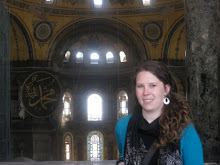
The Hagia Sophia is very unique for the locations use for religions over the years-it was once a Christian Basilica and Roman Catholic Cathedral over the years with similar styles in architecture to the ones I had seen in Italy years earlier. But it has also over the years been used as a Byzantine Mosque after the fall of Constantinople by the Ottoman Turks. In the center front of the building where an alter used to be now stands a mithrab and on the four corners of the building are large wood plates on which are in detailed Arabic calligraphy the names on Allah and Muhammad and other well known figures in Islam. It is a very unique and beautiful place that has seen many world events and wars and has still stood. Many churches stood there previous to the current building the oldest being from the 4th century. There are many cracks in the floors from fires and earthquakes and half deteriorated mosaics from the period of its use as a cathedral depicting Mary and Jesus. It also was once the owner of four bronze horses that They originally belonged to the Hagia Sophia but were plundered during the 4th crusade and now stand outside St. Mark’s Basilica in Venice Italy (which I have also seen).

For more on this amazing building and its history:
http://www.guide-martine.com/istanbul_3.asp

Immediately following this tour we went to the Blue Mosque which is within the same area. This mosque is in amazing condition and gets it name for the wonderful beautiful blue detailed tile work found through the whole inside of the building. It was also the first place I had been to where I’d seen stain glass calligraphy designs in Arabic. It is also unique for its 6 minarets which is uncommon most mosque have 2 some have 4 but very few have 6 which makes people believe that this mosque could have been modeled after the famous mosque in Mecca which also has 6 minarets.
After this several of the MESP girls students and I toured the grand Baazar which was a winding maze inside dark and slightly musty but warmer than it was outside. Everywhere you turn there is jewelry, stain glass lanterns, pipes, hookahs, pottery, silk scarves, restaurants ,Turkish tea sets and so much more. That day we just took it all in and wandered and found out prices of things. Afterward myself and one other student walked around and found another mosque nearby known as Sultan Faithas and also found Istanbul University. We got a snack at a local fast food place that serves mostly pastries stuffed with cheese meat and vegetables or potato. We being cold and tired ventured to discover the transit system and found where to buy tickets got tokens and took the metro back to the other side of the Bosporus then took a wire car/trolley up the hill to the hotel.


The picture to the right is of the blue mosque exterior-the one on the left is me in the Hagia Sophia

Ok well that believe it or not was one very long day-so I will make these shorter than my previous entries and work at one thing at a time
Next: visiting the Ottoman Palace grounds and the Bazaar and Souq shopping.

Wednesday, May 12, 2010

In review . . .

So I know it has been months since I have last written (or posted pictures) and for that I apologize. The schedule and constant moving of travel component got to me and the next thing I knew the semester was over. So short and sweet update: travel component ended, went back to Egypt for 2 weeks, finished papers, said goodbye, went home, went up to Seattle, graduated.

So that is the short of it- now for those who are nervous that I am about to dismiss this blog based on that summary-don’t be. I will be review and reflecting on what I did not write about so that I can remember it and I will (for real this time) post pictures with it as well.

So you can look back on my last semester with me from my journals and memories starting at the point I left off at - from the beginning of travel component.

Friday, April 2, 2010

Travel component overview

Amanda Halvorson
So I first want to apologize for the lack of keeping up with everyone on my travels and adventures. I have been on the travel component portion of my semester and there has been on and off internet access as well as very busy days. There is no way I can in one blog detail all that I have seen and done in a mere two and a half weeks but I will make a list of the most significant moments:
Turkey:
Istanbul
-tour of the Bosporus straight-between the Marmar sea and Black Sea
-visit of Ottoman Palace, Blue Mosque, and Hagia Sophia
-Visiting (and shopping) in the oldest Bazzar/Souq
Ankara
-Tour of the tomb and museum to Ataturk-the country’s founder
And many other very important events and experiences which I will detail later

Syria
-flew from Ankara to where most people would know as ancient Antioch then drove to Syria
-stayed a few days in the capital: Damascus
- toured the old city-street called straight and Ananias’ house where Paul went to receive prayer and sight back and the very famous Ummayyad Mosque
-got ice cream from the oldest ice cream place in the world-in Damascus
- went to a Aramaic speaking village (Maaloula) and monasteries in the hills of Syria
-visited the Krack des Chevaliers-old Crusader fortress/Castle
-went to traditional Syrian Hamman (bath house)

Jordan
-Went to the Dead Sea-and floated and read in the water

Israel/Palestine
-Just arrived two days ago from Jordan and will be living in Jerusalem for two weeks through the holidays of Good Friday and Easter and will traveling throughout the region as well.

This is the most current update and I know it is brief and explains very little but I hope to add details in the future. I want to also apologize for the lack of pictures –my camera is currently broken but I hope to be able to get if fixed very soon.